Why behavioural intelligence is becoming the missing strategic capability
For more than three decades, the MedTech industry has invested billions in understanding two things exceptionally well: what clinicians buy and whether technologies deliver the expected clinical outcomes. Yet it has invested remarkably little in understanding the one factor that ultimately determines both: how clinicians actually make decisions in everyday practice.
This imbalance has shaped how companies gather intelligence, allocate resources, and set strategy. Commercial data reveals market adoption. Clinical evidence validates efficacy and value. Both are indispensable. Together, they underpin forecasting, regulatory strategy, reimbursement, portfolio planning, and commercial execution.
However, neither fully explains why clinical practice changes—or when those changes will appear in the numbers. What is missing is a clear understanding of the decisions that sit between strong evidence and real-world market outcomes. Behavioural intelligence is the missing layer that explains how clinical evidence becomes commercial performance.
This challenge is not unique to MedTech. Consumer goods companies have spent decades investing in continuous behavioural tracking to understand purchasing habits, brand perceptions and changing consumer preferences long before those shifts become visible in sales data. MedTech has become highly sophisticated in commercial and clinical intelligence but has been slower to develop an equivalent behavioural capability.
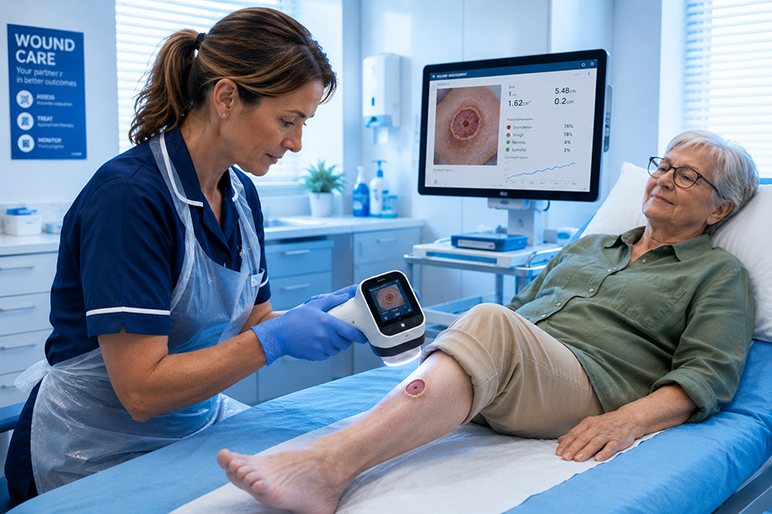
In categories such as advanced wound care, ostomy management, continence care, vascular access and other clinician-driven MedTech areas, decisions involve constant trade-offs that traditional data streams rarely reveal in real time. As care moves into community and home settings and patient complexity rises, the cost of operating without this layer becomes increasingly clear. Companies frequently encounter frustratingly slow adoption curves, persistent unmet needs despite strong clinical evidence, and competitive shifts in directions that cannot be predicted by clinical evidence alone and are identified by existing intelligence systems only once they are already established.
Many companies and leaders within their respective categories sense this limitation. They know frontline behaviour drives everything else, yet they lack a systematic, ongoing view of how it is evolving.
The Three Intelligence Systems

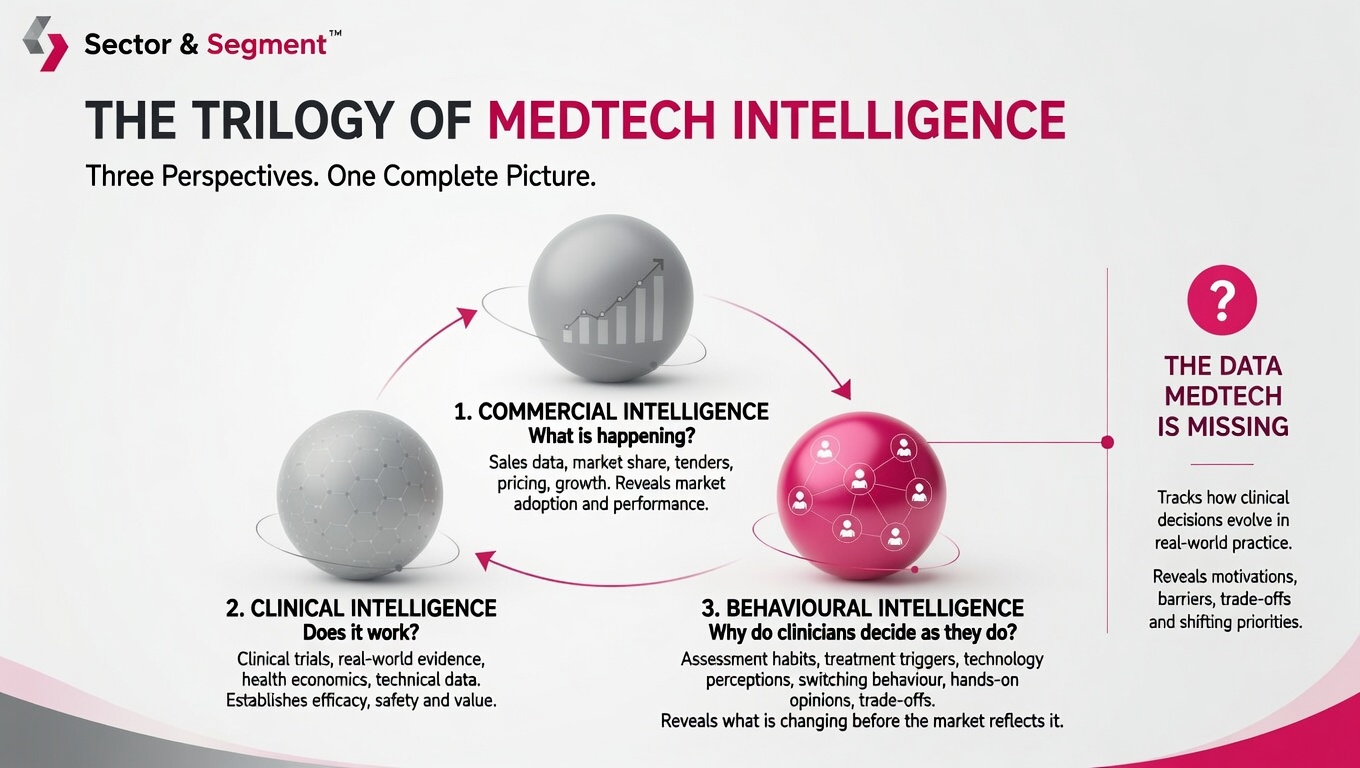
There are three fundamental intelligence systems that can inform strategic decision-making in MedTech. Yet, in most organisations, only two are embedded as systematic, enterprise-wide capabilities.
1. Commercial Intelligence: What is happening?
Sales databases, tender monitoring, distributor reports, and syndicated sources such as IQVIA deliver precise data on volumes, market share, pricing and growth. These are essential for forecasting and performance tracking, but they remain lagging indicators.
2. Clinical Intelligence: Does it work?
Randomised trials, real-world evidence, health economic studies, and technical evaluations establish safety, efficacy and value. This is foundational for regulatory approval and reimbursement, yet it reflects controlled conditions and cannot predict precisely how technologies will perform within the complexity of everyday clinical practice.
3. Behavioural Intelligence: Why do clinicians decide as they do?
This layer systematically tracks how clinical decision-making evolves. It examines assessment habits, treatment escalation triggers, perceptions of different technologies, hands-on opinions on clinical use, switching behaviour, and trade-offs in real-world conditions.
Commercial intelligence and clinical intelligence are well-established strategic disciplines within MedTech. Behavioural intelligence remains significantly less developed as a strategic capability. Yet as care pathways become more complex, treatment decisions become increasingly fragmented, and clinician decision-making more nuanced, it is rapidly emerging as the third pillar of MedTech intelligence.
Sales data tells you what happened. Clinical evidence tells you what could happen. Behavioural intelligence reveals what is changing before the market fully reflects it.
Why Bespoke Research Falls Short
When markets behave in unexpected ways, a common reflex is to commission bespoke market research projects. These studies provide answers to targeted questions, but they deliver isolated snapshots that are of limited value in detecting strategic blind spots. A further limitation is time. Ad hoc studies provide a clear picture at a specific point in time, but rarely continuous tracking. Because each project requires fresh design, fieldwork and analysis, repeating them at meaningful frequency becomes prohibitively expensive. As a result, most organisations operate with intermittent visibility, missing the gradual but decisive shifts in clinician behaviour that eventually reshape tenders, market share and category growth.
Behavioural Intelligence as the Leading Indicator
Behavioural intelligence addresses this gap by providing a forward-looking view of clinical decision-making. When measured longitudinally, it surfaces exactly when and why clinicians begin escalating from one dressing category to another in wound care, how perceptions of silver versus non-silver antimicrobials are shifting, or which practical barriers (beyond clinical endpoints) most often block adoption. In ostomy care, it reveals whether leakage management or skin protection is becoming the dominant driver of convexity use across markets.
This insight sharpens every function. Innovation teams prioritise features that actually move the needle in practice. Medical affairs focuses evidence generation on the clinical endpoints clinicians care about most. Commercial teams craft messages rooted in real decision language. Strategic planning gains early warning of threats and opportunities that sales data will only confirm later.
Completing the Intelligence Picture
The MedTech industry has become exceptionally skilled at measuring what is sold and what works in clinical trials. Its next source of advantage lies in systematically measuring what clinicians actually do and why.
The next generation of MedTech leaders will not replace commercial intelligence or clinical evidence. They will complement them with behavioural intelligence. Organisations that successfully integrate all three will be better equipped to anticipate market shifts, align innovation with frontline practice, and build more resilient competitive strategies.
Sector & Segment has developed specialised behavioural intelligence platforms, including WoundScope for advanced wound care and StomaScope for ostomy management (with parallel solutions for continence), to help close this gap. Designed as annual longitudinal benchmarking programmes, they deliver consistent, point-of-care insight that complements traditional data sources while providing a more consistent and cost-efficient alternative to repeatedly commissioning bespoke studies.
In an industry that has mastered measuring products and outcomes, the next competitive advantage will come from measuring the decisions that connect them.
For more information or to discuss how behavioural intelligence can support your organisation's strategy, innovation or commercial planning, contact us at info@sectorandsegment.com.