Related
See More 


In recent years, cardiac navigation systems have rapidly advanced, becoming essential tools in the field of electrophysiology. These systems, which combine cutting-edge software and hardware, are transforming the landscape of cardiac care, enabling more precise and effective interventions. As the healthcare industry increasingly prioritizes minimally invasive procedures, the role of these technologies is becoming ever more critical.
The market for cardiac navigation systems has been traditionally dominated by three key players - Biosense Webster's CARTO System, Abbott's EnSite, and Boston Scientific's RHYTHMIA HDx -, each contributing significantly to the technology's development and adoption. However, recent innovations and regulatory milestones from companies like Stereotaxis and Corify are beginning to reshape this landscape. These developments highlight the continuous evolution of cardiac navigation technology, driven by both established leaders and pioneering newcomers. As these systems continue to evolve, their impact on patient care and clinical practices is expected to grow significantly, setting the stage for their expanded use in the coming years
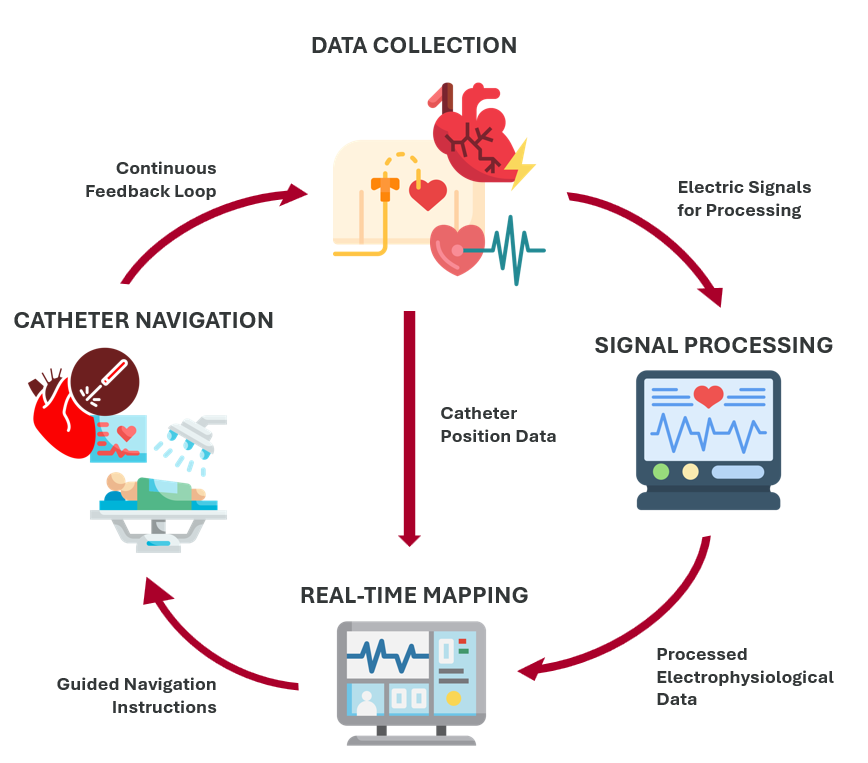
Imagine navigating through the intricate maze of the heart’s electrical circuits with pinpoint accuracy - this is the everyday reality of modern electrophysiology, made possible by advanced cardiac navigation systems. These systems have revolutionized the field by providing physicians with essential tools for mapping the heart's electrical activity and guiding catheters during procedures (Figure 1).
Despite their complexity, all systems share a foundational structure composed of software, hardware, and disposables, and can be broadly categorized based on the tracking technologies they employ, with each modality offering distinct advantages in clinical practice.
At their core, cardiac navigation systems must accomplish three essential tasks. First, they need to safely guide a catheter through the heart by accurately tracking and mapping the physical space in real-time. Second, they must help identify abnormal areas of electrical activity that contribute to arrhythmias. Finally, they should confirm when the issue has been resolved, using electrical signals to verify the effectiveness of the treatment. These foundational capabilities form the basis for the technological advancements seen in various tracking modalities.
As mentioned earlier, every cardiac navigation system relies on three essential components: software, hardware, and disposables (Figure 2). Each of these plays a crucial role in the system’s overall functionality, working together to ensure that procedures are both accurate and efficient: